

When I first left my corporate job to work for myself, I remember sitting at my desk with a cup of coffee, staring at a private health insurance quote of $550 a month. As a healthy guy in my late twenties, that number felt like a bad joke. It was a massive chunk of my monthly budget just to ensure I wouldn’t go bankrupt if I broke a leg.
Out of pure frustration, I started digging into how the Affordable Care Act (ACA)—more commonly known as Obamacare—actually calculates its numbers.
What I discovered completely changed my financial trajectory. I realized that millions of people are completely overpaying for health insurance—or going without it entirely—simply because they don’t understand how to navigate the system’s rules. The truth is, depending on how you report your income and pick your plan, you could qualify for deeply discounted or completely free ($0 premium) health insurance.
If you are currently uninsured, self-employed, or working a job that doesn’t offer benefits, this is the real, unfiltered guide on how the system works and exactly how to claim your savings.
The Big Shift: Understanding the Marketplace Rules
If you looked at the ACA Marketplace a couple of years ago, the rules were different. For a while, federal enhancements made plans incredibly cheap for almost everyone. However, those temporary enhancements expired, which means the marketplace has returned to its traditional layout.
The standard rule is back: to get a premium tax credit (the government subsidy that lowers your monthly bill), your household income generally needs to fall between 100% and 400% of the Federal Poverty Level (FPL).
What does that actually look like in dollars? Let’s look at the baseline brackets used to determine financial assistance:
| Household Size | 100% FPL (Minimum for Subsidies) | 400% FPL (Maximum for Subsidies) |
| 1 (Individual) | ~$15,960 / year | ~$63,840 / year |
| 2 (Couple) | ~$21,640 / year | ~$86,560 / year |
| 3 (Family of 3) | ~$27,320 / year | ~$109,280 / year |
| 4 (Family of 4) | ~$33,000 / year | ~$132,000 / year |
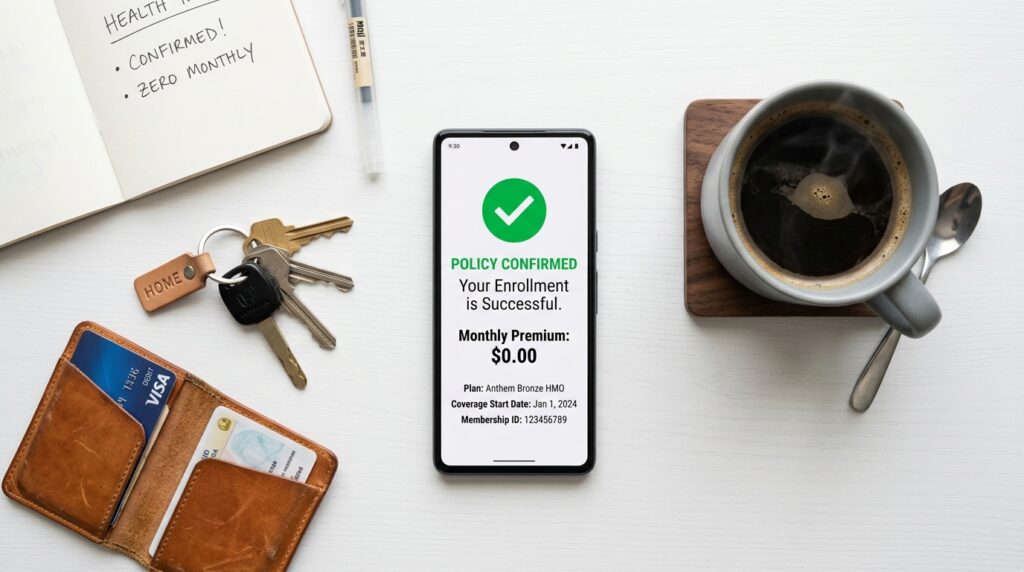
The Secret Window: If your income is hovering anywhere near the lower end of these brackets (close to the 100% to 150% FPL mark), the government subsidies are so aggressive that they will completely cover the cost of certain baseline plans. This is exactly how you score a $0 premium monthly bill.
The Two Paths to Free or Low-Cost Coverage
Depending on your income, the official exchange will route you into one of two distinct cost-saving programs.
Path A: Medicaid Expansion (Income below 138% FPL)
If you live in one of the 40 states (plus Washington, D.C.) that chose to expand Medicaid, and your income falls below 138% of the poverty level (roughly $22,025 a year for an individual), you don’t even need to buy a marketplace plan.
The system will automatically route you into your state’s Medicaid program. This isn’t just low-cost insurance; it is completely free. There are zero monthly premiums, and your copays at the doctor or pharmacy are usually pocket change ($1 to $5).
- The Catch: If you live in one of the 10 states that refused to expand Medicaid (like Texas, Florida, or Georgia), this safety net isn’t available to childless adults, creating a tough “coverage gap” if you earn under 100% FPL.
Path B: The Silver Plan “Sweet Spot” (Income 100% – 250% FPL)
If your income is too high for Medicaid, or you live in a non-expansion state, you drop into the standard ACA Marketplace. This is where most people make a critical error: they look for the cheapest monthly price and blindly buy a Bronze plan.
If your income is between 100% and 250% of the poverty level, you should almost always buy a Silver Plan.
Why? Because Silver is the only metal tier eligible for something called Cost-Sharing Reductions (CSRs). These are hidden, automatic upgrades funded by the government. When you select a Silver plan within this income window, the system artificially lowers your deductible, slashes your copays, and caps your maximum out-of-pocket exposure. You essentially get a premium Gold-level plan for a heavily discounted Silver price.
Step-by-Step: How to Secure a $0 or Low-Cost Plan
Ready to shop? Do not type “cheap health insurance” into a generic search engine, or your phone will ring off the hook with spam calls from predatory brokers selling non-compliant plans. Follow this exact blueprint instead:
1.Navigate to the Correct Exchange:Takes 2 mins.
Open your browser and go directly to HealthCare.gov. If your state runs its own independent health exchange (like California, New York, or Pennsylvania), the portal will automatically redirect you to your state’s official state-run site.
2.Calculate Your MAGI (Income):The most critical number.
The exchange calculates your financial help based on your Modified Adjusted Gross Income (MAGI) for the upcoming year, not what you made in the past. If you are self-employed, take your gross business revenue and subtract your legitimate business deductions (like software subscriptions, materials, and marketing costs) to find your net income.
3.Filter Results and Check the Silver Tier:Look for $0 options.
Once you enter your household details and income, the system will show your personalized subsidy. Sort the available plans by premium. If your income falls in the lower tiers, you will see multiple Bronze or Silver plans listed at exactly $0.00 per month.
4.Verify the Network and Formulary:Check doctors and drugs.
Before clicking “Enroll,” click on the plan details. Copy and paste your primary care doctor’s name into their provider directory to ensure they are in-network. Do the same for any regular prescription medications you take to ensure they are covered on the plan’s formulary.
3 Costly Pitfalls to Avoid
Navigating the marketplace requires you to be precise. One bad assumption can cost you thousands of dollars when tax season rolls around.
- The “Subsidy Cliff” is Back: During the pandemic era, the government removed the upper income cap for subsidies. That perk is officially gone. If your household income crosses over 400% of the FPL by even a single dollar, you hit the “subsidy cliff.” Your financial help drops to zero instantly, and you are forced to pay the full, unsubsidized retail price for your plan.
- The End-of-Year Tax Reckoning: The marketplace premium discount is technically an “Advanced Premium Tax Credit.” The government sends this money directly to the insurance company every month based on the income you estimated when you signed up. If you pick up a high-paying client mid-year and fail to update your account, the IRS will calculate your true earnings when you file your taxes and claw back the overpaid subsidies directly out of your tax refund.
- Falling for “Healthcare Sharing Ministries”: These are non-insurance arrangements often marketed alongside cheap plans. They do not comply with the ACA. They are legally allowed to deny coverage for pre-existing conditions, refuse to pay for mental health care, or simply run out of money when you file a major claim. Stick strictly to compliant plans on the official state or federal exchange.
Final Thoughts
Health insurance can feel like an incredibly stressful expense, but the ACA marketplace is designed to be highly malleable if you know how to report your income accurately and utilize the system’s brackets. If you find yourself working independently or facing a sudden job transition, do not leave your health to chance.
Take an hour out of your day to log onto HealthCare.gov, plug in your realistic net income projections, and look closely at the Silver plans. Taking control of the data is the fastest way to shield both your physical health and your bank account.