

A few years ago, I decided to leave my steady, corporate software development job to go full-time freelance. I budgeted for everything: laptop upgrades, cloud storage, self-employment taxes, and even coffee shop runs. But the morning I sat down to find my own health insurance on the open market, my excitement turned into pure sticker shock.
Without an employer picking up 80% of the tab, the raw monthly cost staring back at me from the screen felt like a second rent payment.
If you are transitioning to contract work, running your own small business, or simply looking at your current company health insurance deductions wondering, “Is this actually a normal amount to pay?”—you are facing one of the most confusing, non-transparent systems in America.
Health insurance pricing isn’t a single flat rate. It’s a shifting calculation based heavily on how you get your coverage, where you live, your age, and your household income. Let’s pull back the curtain on what health insurance actually costs per month, what those “metal tiers” really mean for your wallet, and how you can avoid overpaying.
The Master Baselines: What Does Health Insurance Cost?
When trying to figure out an average monthly cost, the very first question you have to ask is: Who is paying the master bill?
There are two completely separate worlds of health insurance in the US: Employer-Sponsored Plans (where your company subsidizes the cost) and the ACA Marketplace / Obamacare (where you buy a plan directly as an individual).
According to comprehensive national health data from organizations like the Kaiser Family Foundation (KFF), the baseline costs break down like this:
1. If You Get Insurance Through Your Employer
If you work a traditional W-2 job, your company covers the vast majority of the premium. You only pay a slice of the total bill, which is automatically deducted from your paycheck pre-tax.
- Single Coverage: The average employee pays about $114 a month (the employer covers the remaining ~$663).
- Family Coverage: The average employee pays about $525 a month (the employer covers the remaining ~$1,725).
2. If You Buy Individual Insurance on the ACA Marketplace
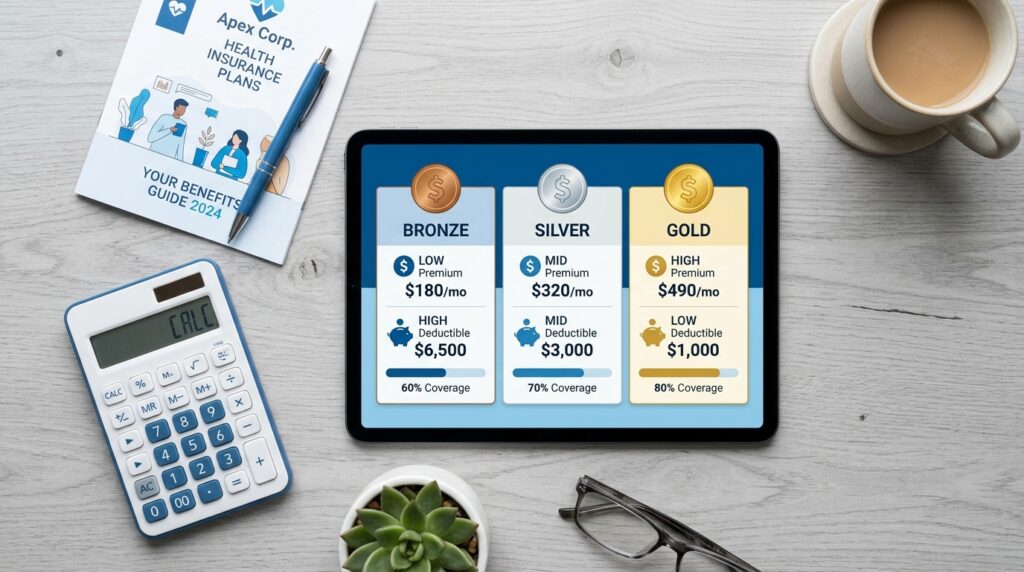
If you are a freelancer, entrepreneur, or gig worker buying an individual plan without an employer subsidy, the unsubsidized baseline rates change depending on the level of financial protection you choose. The system uses “Metal Tiers” to categorize plans:
| Plan Tier | National Monthly Average (Age 40) | Best For |
| Bronze | $381 / month | Young, healthy individuals who rarely see a doctor and want protection against major medical disasters. |
| Silver (Benchmark) | $497 / month | The middle-ground baseline. Best for average health needs and the only tier eligible for cost-sharing reductions. |
| Gold | $507 / month | Higher monthly cost, but significantly lower deductibles. Best for frequent doctor visits or ongoing prescriptions. |
The Stealth Subsidy Window: While $497 a month sounds incredibly steep for a Silver plan, the vast majority of people shopping on the Marketplace do not pay the full sticker price. Thanks to federal premium tax credits, if your household income falls within 100% to 400% of the federal poverty level, your true out-of-pocket cost can drop significantly. In fact, subsidized Marketplace enrollees pay an average of just $66 a month.
Decoding the Hidden Costs: It’s Not Just the Premium
When I bought my first individual plan, I made a massive rookie mistake: I sorted the results by “Lowest Premium” and blindly clicked buy on a cheap Bronze plan. I thought I was being financially savvy.
Three months later, I twisted my ankle and needed an X-ray and a specialist visit. That’s when I learned the hard way that a low monthly premium is almost always a trap if you actually end up needing medical care.
Your monthly bill is only one part of the financial equation. You have to understand three other terms to know your true exposure:
- The Deductible: This is the amount of money you must pay entirely out of your own pocket for medical care before your insurance company kicks in a single dime. For a standard Bronze plan, individual deductibles can easily sit around $7,400.
- The Copay / Coinsurance: A copay is a fixed flat fee you pay at the doctor’s office (e.g., $30 for a regular checkup). Coinsurance is a percentage split (e.g., you pay 20% of an emergency room bill, and the insurance company covers the other 80%).
- Out-of-Pocket Maximum: The most important number on your policy. This is the absolute legal limit of what you could possibly pay for covered medical services in a calendar year. If you have a catastrophic medical event, once your deductibles, copays, and coinsurance hit this cap (typically around $9,000 for an individual), your insurance pays 100% of everything else.
Step-by-Step: How to Shop for the Best Rate
If you need to source your own health insurance, do not just open Google and click on random ads. You will end up on “spam lists” that will result in dozens of telemarketing calls a day from non-compliant brokers selling junk insurance. Follow this exact procedural framework instead:
1.Go to the Official Portal:Avoid spam sites.
Open your browser and navigate directly to Healthcare.gov. If your state runs its own independent exchange (like Covered California or NY State of Health), the site will automatically redirect you to the correct state portal. This is the only place where legitimate, ACA-compliant plans live.
2.Input Accurate Income Estimates:Crucial for discounts.
The portal will ask you to estimate your net household income for the upcoming year. Be as accurate as possible. The system will use this data to instantly calculate your Premium Tax Credit, showing you the actual, reduced monthly cost of each plan side-by-side.
3.Filter by Network Type (HMO vs. PPO):Match your medical needs.
Look at the network types. An HMO (Health Maintenance Organization) is typically cheaper but requires you to stay strictly within a local network of doctors and get referrals for everything. A PPO (Preferred Provider Organization) costs more per month but gives you the freedom to see any specialist you want without a gatekeeper.
4.Audit the Plan’s Formulary:Check your prescriptions.
Before clicking buy, open the plan details and check their “Formulary” (their master list of covered medications). Make sure your regular prescriptions are covered in an affordable tier, and double-check that your primary doctor is listed in their active provider directory.
3 Critical Mistakes to Avoid
- Buying “Short-Term” Health Insurance: If you see an online plan that costs an incredibly cheap $80 a month without a government subsidy, read the fine print. It is likely a “short-term health plan” or a indemnity plan. These plans are not bound by the Affordable Care Act. They can—and will—deny you coverage for pre-existing conditions, refuse to cover prescription drugs, or drop your coverage entirely if you get seriously ill.
- Underestimating Freelance Income: If you are self-employed and overestimate your income on the exchange, you will miss out on monthly savings. Conversely, if you underestimate your income and make significantly more money than you reported, the IRS will claw back those monthly premium subsidies when you file your annual tax return. Update your income on the portal the moment your business revenue fluctuates.
- Ignoring Health Savings Accounts (HSAs): If you choose a High-Deductible Health Plan (HDHP), make sure it is explicitly labeled as HSA-compatible. A Health Savings Account allows you to funnel pre-tax money into a dedicated account to pay for medical expenses. That money rolls over year after year, grows completely tax-free, and acts like a stealth retirement account for your health.
Final Thoughts
Health insurance is inherently an expensive line item, but it shouldn’t be an unguided gamble. If you have access to an employer plan, maximizing that benefit is almost always your cheapest route. If you are out on your own, your strategy should center on playing the subsidy rules to your advantage on Healthcare.gov, matching your plan choice to your actual annual medical usage, and protecting yourself against catastrophic out-of-pocket limits.
Take an afternoon during the Open Enrollment period (which typically runs from November 1st to January 15th every year) to audit your options—getting the math right can easily save you thousands of dollars over the course of the year.