
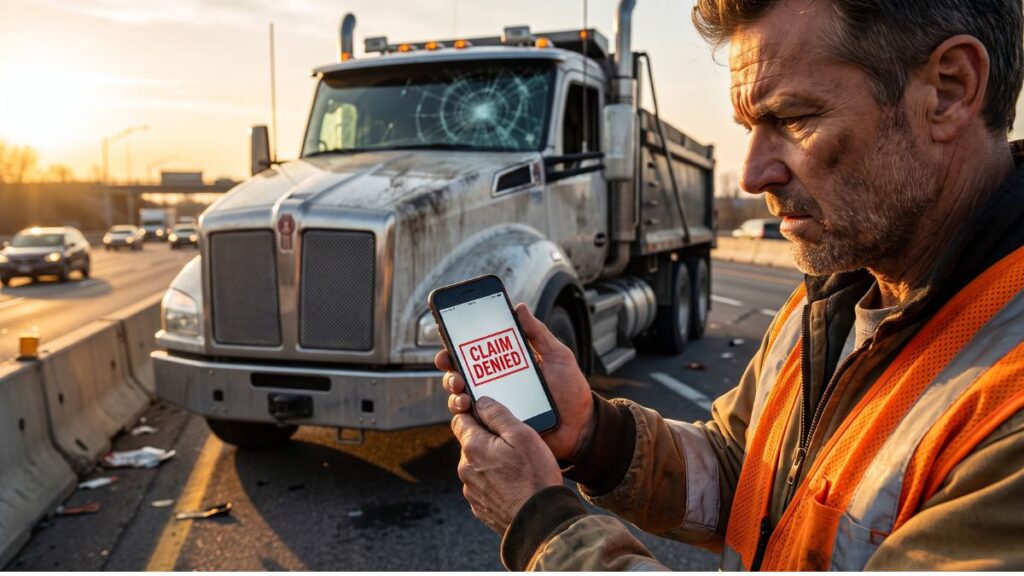
Last November, a contractor buddy of mine—let’s call him Dave—drove his work truck to a weekend family barbecue. He wasn’t picking up supplies, hauling gravel, or heading to a job site. He was simply driving his daily work vehicle to grab some groceries and drop his kids off at a soccer game.
On the way home, a distracted driver ran a red light and slammed straight into the passenger side of his Ford F-250.
Dave wasn’t at fault, but the other driver was severely underinsured. Dave naturally filed a claim under his commercial auto policy, assuming he was fully covered. After all, he paid over $350 every single month for that policy.
Two weeks later, he got a certified letter in the mail. Claim Denied.
Why? Because his policy had a strict “business-use only” clause. The insurer argued that driving to a family weekend cookout was a purely personal errand, meaning his commercial auto policy didn’t apply. To make matters worse, when he tried to route it through his personal auto insurance, they rejected it too because the truck was registered under his LLC.
Dave was left holding a $50,000 repair and medical bill out of his own pocket.
If you own a small business, trade, or freelance operation where your work vehicle doubles as your personal ride, this hidden legal coverage gap is a ticking time bomb. Let’s break down exactly how this works, why insurers deny these claims, and how you can protect your wallet before a Sunday afternoon drive wipes out your savings.
The Gray Area: Commercial Auto Insurance vs Personal Coverage
Most small business owners assume that having “commercial insurance” means they have an upgraded, bulletproof version of personal insurance. That is one of the most expensive misconceptions in the business world.
When comparing commercial auto insurance vs personal coverage, the fundamental difference isn’t the size of the truck—it’s the intent of the drive.
- Personal Auto Insurance: Designed exclusively for individual daily living. Commuting to a W-2 job, running errands, road trips, and weekend drives. It explicitly excludes any activity where you carry goods for trade, transport paying passengers, or use the vehicle to generate revenue.
- Commercial Auto Insurance Coverage: Built to cover liability, property damage, and legal costs arising from business operations. It covers tools, employee drivers, higher gross vehicle weights (GVW), and heavy liability limits.
+-----------------------------------------------------------------------+
|                         THE COVERAGE GAP                              |
+-----------------------------------------------------------------------+
|  Personal Policy Excludes:   ---> Business errands & commercial use   |
|  Commercial Policy Excludes: ---> Unendorsed personal/off-clock use   |
|                                                                       |
|  [THE TRAP]: Driving a commercial vehicle for personal reasons        |
|              WITHOUT a "Drive Other Car" or "Personal Use" endorsement.|
+-----------------------------------------------------------------------+
Here is where the trap springs: Personal policies refuse to cover commercial vehicles, and standard commercial policies often refuse to cover off-clock personal drives.
If you find yourself stuck in the middle of this gray zone during an accident, both insurance companies will point fingers at each other, leaving you with zero coverage.
The Big Question: Does Commercial Auto Insurance Cover Personal Use?
The short answer? Not by default.
The long answer depends entirely on how your policy is structured, who owns the vehicle, and what endorsements (add-ons) you have attached to your plan.
If your vehicle is titled under an LLC or Corporation, the insurance company views the vehicle as a tool owned by a business entity. A business entity doesn’t go to the movie theater, pick up kids from school, or take beach vacations. Therefore, unless you explicitly state in your contract that the vehicle will be used for non-business driving, the adjuster will treat off-clock usage as an unapproved risk.
Here are four real-world scenarios where business owners get caught off-guard:
Scenario A: Running a “Quick Personal Errand” During Work Hours
You’re driving between two client sites and stop at a fast-food drive-thru or grab a personal haircut.
- The Verdict: Usually covered. Most insurers consider minor detours during a workday as “incidental personal use.”
Scenario B: Weekend Family Road Trips
You hook a camper to your commercial heavy-duty truck and drive three states over for a family vacation.
- The Verdict: Denied. This is a clear breach of standard commercial terms unless you have specific endorsements attached.
Scenario C: Employee Taking the Vehicle Home
You allow an employee to park a company van at their house overnight, and they take it out late at night to visit a friend.
- The Verdict: High risk of denial. Unless the employee is listed as a designated driver with permitted personal use, insurers will fight the claim.
Scenario D: Mixed-Use Sole Proprietorships
You are a handyman using your personal SUV for work, holding standard personal insurance without telling your provider you haul equipment.
- The Verdict: Denied. If an adjuster finds ladders, branded magnets, or invoices in your trunk, your personal claim will be thrown out for fraud or material misrepresentation.
How Much Is Commercial Auto Insurance Per Month? (State-Wise Rates Breakdown)
A major reason business owners end up with inadequate coverage is that they try to cut corners on premiums. Commercial vehicle coverage isn’t cheap, but skimping on essential endorsements to save $30 a month can cost you tens of thousands later.
So, how much is commercial auto insurance per month on average across the United States?
For a single light-to-medium work vehicle (like a pickup truck, cargo van, or sedan), small business owners pay anywhere between $125 and $300 per month ($1,500 to $3,600 annually). However, premiums fluctuate wildly based on location, business type, and state-mandated minimum liability rules.
Let’s look at how state regulations dramatically impact your monthly bills:
+--------------------------------------------------------------------+
|               ESTIMATED MONTHLY COMMERCIAL AUTO RATES              |
+--------------------------+-----------------------------------------+
| State / Region           | Average Monthly Cost (Per Vehicle)      |
+--------------------------+-----------------------------------------+
| National Average         | $150 - $250 / month                     |
| Colorado                 | $160 - $280 / month                     |
| Illinois                 | $140 - $240 / month                     |
| Arizona                  | $155 - $265 / month                     |
| Michigan (No-Fault)      | $220 - $410+ / month                    |
+--------------------------+-----------------------------------------+
1. Commercial Auto Insurance Colorado
Colorado requires minimum liability limits of $25,000/$50,000/$15,000. However, due to harsh winter weather, mountain driving risks, and high hail-damage claim volumes, commercial rates in Colorado tend to run slightly higher than the national average. Contractors operating in mountain zones often pay higher comprehensive rates.
2. Commercial Auto Insurance Illinois
Illinois has heavy commercial traffic around Chicago and strict transit enforcement. State minimums match standard thresholds, but most commercial lenders force you into $1,000,000 combined single limit (CSL) policies. The presence of freight corridors makes uninsured motorist coverage a critical—and costly—necessity here.
3. Commercial Auto Insurance Arizona
Arizona features a booming construction and trade market. While weather claims are low, high rates of auto theft and uninsured motorists keep premiums elevated. If you haul heavy equipment across desert highways, heat-related tire blowouts are a frequent cause of commercial claims.
4. Commercial Auto Insurance Michigan
Michigan is historically one of the most expensive states for commercial vehicle insurance. Because of its unique No-Fault Insurance system and mandatory Personal Injury Protection (PIP) requirements, monthly premiums here can easily exceed $300 to $400 per month for basic commercial work vans.
The Two Endorsements That Save You From Financial Ruin
If you drive your work vehicle off the clock, you don’t need to sell your truck or buy a second personal car. You simply need to ask your insurance agent to add one (or both) of these essential legal riders to your policy:
                  +-----------------------------------+
                  |   ESSENTIAL POLICY ENDORSEMENTS   |
                  +-----------------------------------+
                                    |
         +--------------------------+--------------------------+
         |                                                     |
         v                                                     v
+----------------------------------+         +----------------------------------+
|      Drive Other Car (DOC)       |         |   Permissible Personal Use   |
+----------------------------------+         +----------------------------------+
| Ideal for: LLC/Corp Owners       |         | Ideal for: Sole Proprietors      |
| Covers: Driving non-owned cars,  |         | Covers: Weekend errands,         |
| rental vehicles, and personal    |         | family trips, off-clock driving  |
| errands when no personal policy  |         | in company-owned vehicles.       |
| exists.                          |         |                                  |
+----------------------------------+         +----------------------------------+
1. Permissible Personal Use Endorsement
This rider explicitly tells the insurance company: “Hey, this vehicle is owned by my business, but I (and my spouse) will be driving it for personal errands on weekends and evenings.”
It bridges the gap completely. If you get into an accident while driving to a family dinner, the insurer cannot deny the claim based on non-business usage. Adding this endorsement usually increases your premium by just 5% to 10% per year—a tiny price to pay compared to a $50,000 denied claim.
2. Drive Other Car (DOC) Endorsement
If your business owns all your vehicles and you do not hold a separate personal auto policy in your own name, you have a massive legal blind spot.
If you rent a car on vacation or borrow a friend’s sedan, your company’s commercial policy won’t cover you personally because you aren’t driving the specific company vehicle. A Drive Other Car (DOC) endorsement treats the business owner and their spouse as if they have a personal auto policy, extending liability protection to any car they drive anywhere.
Step-by-Step: How to Audit Your Vehicle Policy in 15 Minutes
Don’t wait for an accident to find out if you’re covered. Take these five steps today to audit your setup:
[STEP 1] Check Title Registration ──> Is it under your Name or LLC?
   │
[STEP 2] Inspect Policy Declarations ──> Look for "Commercial Use Only" restrictions.
   │
[STEP 3] Review Driver List ──> Are family members/spouses listed?
   │
[STEP 4] Call Your Agent ──> Ask specifically about "Off-Clock Personal Use."
   │
[STEP 5] Get Adjustments in Writing ──> Secure a written endorsement copy.
Step 1: Check Who Owns the Vehicle
Look at your state vehicle title or registration document. Is the vehicle registered to John Doe or John Doe Contracting LLC?
- If registered to an LLC, you MUST have a commercial policy with a personal use endorsement.
- If registered to you personally, you can run a personal policy only if you add a business-use endorsement to it.
Step 2: Read Your “Declarations Page”
Pull up your insurance PDF and navigate to the Declarations Page. Search for language like “Radius of Operation,” “Symbol 7 (Specified Autos),” or “Business Use Only.” If you see strict commercial definitions without any personal use schedule, you are exposed.
Step 3: Check Your Named Drivers
Are your spouse or teenage children listed on your commercial policy? If your spouse drives the work truck to the home improvement store and hits a pole, the claim will likely be denied if they aren’t explicitly listed as an authorized driver.
Step 4: Ask Your Agent the “Sunday BBQ Test”
Send your insurance agent this exact email:
“Hi [Agent Name], I want to confirm our current coverage. If I am driving our company vehicle [Year/Make/Model] on a Sunday afternoon for a purely personal errand (like taking my kids to the park) and get into an accident, is full liability and collision covered under our current policy? Do we have a Personal Use Endorsement active?”
If they hesitate, hedge, or say “it depends,” demand that they add a personal use rider immediately.
Step 5: Get Everything in Writing
Never rely on a phone call or verbal promise from an agent. Insurance adjusters who review claims after an accident do not care what your broker told you on the phone—they only care about the written legal contract. Make sure the endorsement appears clearly on your updated policy documents.
Real-World Case Studies: When Claims Get Honored vs Denied
To see how fine the line is between an approved check and a legal disaster, consider these three real cases:
Case 1: The Denied Delivery Van
- The Driver: A small bakery owner in Illinois.
- The Incident: He drove his company delivery van to drop off his daughter at college over the weekend. He swerved to avoid a deer on a rural highway and flipped the van.
- The Result: CLAIM DENIED. The adjuster pulled GPS tracking logs showing the trip was 200 miles outside his registered commercial operation radius on a non-business day. Total loss: $32,000.
Case 2: The Covered Plumber
- The Driver: A self-employed plumber in Arizona using a branded pickup truck.
- The Incident: Stopped at a hardware store on Saturday morning to buy personal lawn care supplies. A car backed into his truck in the parking lot.
- The Result: CLAIM PAID. His agent had proactively added a “Permissible Personal Use” rider to his commercial policy for an extra $12 a month. The insurer covered all $6,500 in body repairs without hesitation.
Case 3: The Subcontractor Trap
- The Driver: An independent electrician operating as a sole proprietor.
- The Incident: Used his personal SUV for daily work, keeping ladders on a roof rack. He filed a claim under his personal auto policy after a fender bender during his morning commute.
- The Result: CLAIM DENIED & POLICY CANCELED. The insurance adjuster saw the ladder racks and tools in the photos, deemed it an undisclosed commercial risk, and canceled his policy on the spot for material misrepresentation.
Common Mistakes Small Business Owners Make
To keep your premiums reasonable and your claims paid, avoid these four costly blunders:
- Hiding Business Use from Personal Insurers: Thinking you can save money by keeping your work truck on a personal policy is short-sighted. Insurance adjusters are trained investigators. They will search your social media, look for business branding, check mileage logs, and inspect vehicle contents during a claim investigation.
- Assuming Spouses Are Automatically Covered: On personal policies, spouses living in the same household are usually covered automatically. On commercial policies, they are not. Every single driver must be vetted and explicitly listed on the policy schedule.
- Ignoring State Radius Limits: Many commercial auto policies limit coverage to a specific radius (e.g., within 50 or 100 miles of your business address). If you take a personal road trip past that boundary, your coverage may lapse automatically.
- Failing to Report Upgrades or Equipment: If you install custom toolboxes, wraps, or hydraulic lifts worth $10,000 on your truck, standard comprehensive coverage won’t reimburse those additions unless they are added as schedule items on your commercial policy.
Frequently Asked Questions (FAQs)
Can I write off commercial auto insurance on my taxes if I use the vehicle for personal driving?
Yes, but only proportionally. If you use your vehicle 70% for business and 30% for personal driving, you can deduct 70% of your insurance premiums, fuel, and maintenance expenses as a business expense. Keep a detailed mileage log app (like MileIQ or Everlance) to back up your claim if audited by the IRS.
What happens if an unlisted employee drives my work vehicle for personal reasons?
If an employee takes a company vehicle without permission (unauthorized use), your policy’s commercial liability might protect the business from third-party lawsuits, but damage to your own vehicle will likely be denied. If you gave them permission but didn’t list them on the policy, the entire claim will likely be rejected.
Is standard commercial auto insurance enough if I tow a trailer for personal use?
Not necessarily. Most commercial policies cover the vehicle itself, but attached trailers often require a separate trailer liability endorsement—especially if the trailer is used to haul personal recreational vehicles like boats, ATVs, or campers.
Final Thoughts: Protecting Your Business and Family
Running a business is risky enough without leaving your daily transportation exposed to insurance technicalities. Insurance companies aren’t inherently evil, but they are strict legal entities that operate purely on contract terms. If your contract says “business use only,” they will enforce that restriction to the letter.
Take 15 minutes this week to pull out your insurance documents, call your provider, and ask the hard questions about personal driving. Adding a simple Permissible Personal Use or Drive Other Car endorsement is cheap, fast, and gives you absolute peace of mind whenever you turn the key on an off-clock drive.
Don’t wait for an unexpected fender bender on a Sunday afternoon to discover where your coverage ends. Fix the gap now, protect your hard-earned business assets, and drive with complete confidence.