
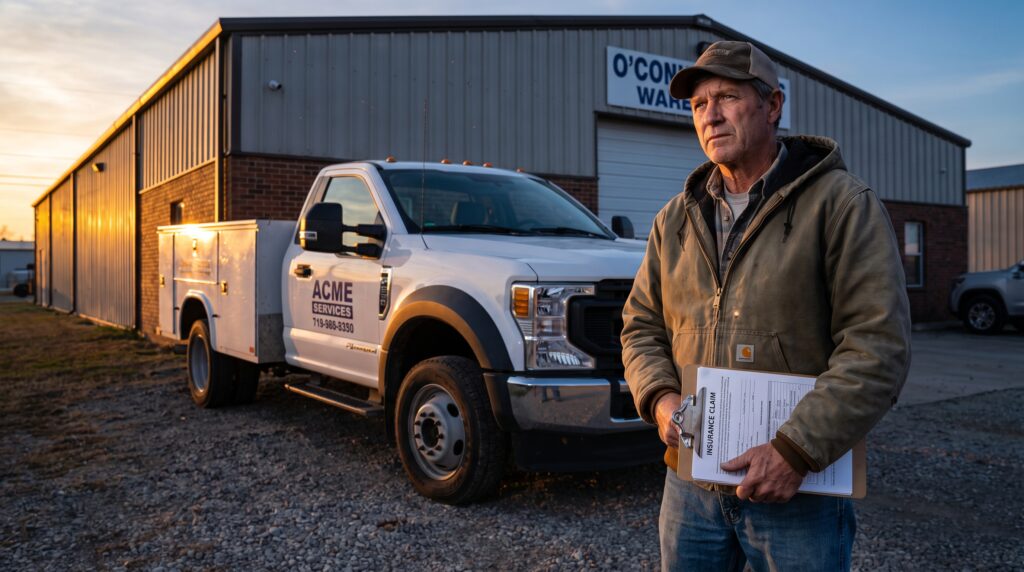
When starting out, most business owners naturally ask: do I need commercial auto insurance or can I just stick with a personal policy?
Eventually, as you buy work vans, pickup trucks, or haul heavy tools, you upgrade to a dedicated commercial policy. You pay higher premiums, sign the paperwork, and assume you are 100% protected 24/7, no matter who is behind the wheel or where the vehicle is heading.
That assumption is the $100,000 trap.
How Insurance Adjusters Evaluate Claims
Commercial auto policies are legally structured around operational business risk. When a claim is filed, insurance adjusters do not just look at what vehicle was hit; they look at the primary intent of the drive.
If an adjuster determines the trip was purely personal—like a Sunday grocery run, a family weekend road trip, or letting an unlisted family member borrow the van—they immediately look for policy exclusions.
Here are the top triggers that lead to immediate claim denials in 2026:
- Unlisted Household Drivers: Allowing a spouse, teenager, or friend who isn’t explicitly listed on your commercial policy declaration page to drive the vehicle.
- Personal Errands Without Endorsements: Using a work vehicle for personal errands outside business hours without attaching personal-use riders.
- Geographic Radius Violations: Driving a commercial truck on a personal vacation 300 miles away when your policy restricts operations to a 50-mile business radius.
- Hauling Non-Business Equipment: Towing personal boats, camper trailers, or personal recreational vehicles using a commercially insured truck.
Commercial Auto Insurance vs Personal: Understanding the Fine Print
To understand why this gap exists, we have to look at commercial auto insurance vs personal policy boundaries. They are designed for entirely different risk profiles.
Plaintext
+------------------------------------+------------------------------------+
| Personal Auto Insurance            | Commercial Auto Insurance          |
+------------------------------------+------------------------------------+
| Designed for individual commuting  | Designed for business operations   |
| Lower liability limits ($25k-$100k)| High liability caps ($500k-$1M+)   |
| Excludes tools, cargo, & client ride| Covers fleet equipment & cargo     |
| Denies work delivery claims        | Denies non-endorsed personal claims|
+------------------------------------+------------------------------------+
If you use a personal vehicle to haul commercial tools, deliver products, or transport paying clients, your personal insurer will deny your claim if you crash while on the job.
Conversely, relying strictly on a commercial auto policy without personal use coverage leaves a massive blind spot the moment you stop driving for work purposes.
How Much Does Commercial Auto Insurance Cost in 2026?
A lot of business owners hesitate to add extra policy endorsements because they are worried about skyrocketing costs. To figure out whether you are paying too much, you first need to answer: how much is commercial auto insurance in today’s market?
In 2026, the national average for commercial auto insurance ranges from $1,200 to $3,500 per year per vehicle for small businesses with light vans or trucks. However, if you manage heavy machinery, cargo transport, or high-risk trades, premiums can easily exceed $5,000+ annually.
Factors That Dictate Your Rates
When asking how much does commercial auto insurance cost, underwriters look at a few main criteria:
- Vehicle Class & Weight: A light Ford Transit van costs significantly less to insure than a heavy-duty dump truck.
- Driver History & Age: Adding young or inexperienced drivers automatically spikes rates.
- State & Location: Insurance premiums fluctuate drastically depending on your home state. Business owners often research what state has the highest auto insurance rates to understand baseline industry risk. States with high traffic density, frequent weather events, and strict litigation environments traditionally see the highest rates nationwide.
- Coverage & Liability Caps: Raising your combined single limit (CSL) from $300,000 to $1,000,000 increases your monthly bill, but it prevents total financial ruin during major multi-vehicle accidents.
Real-Life Scenario: How Modern Telematics Bust Claim Intent
A few years ago, insurance companies relied heavily on police reports and driver statements to figure out how an accident happened. If you said you were on your way to buy supplies for a job site, they generally took your word for it.
That age of guesswork is over.
In 2026, modern commercial fleet policies routinely integrate dashcams, electronic logging devices (ELDs), and mobile telematics apps.
When my contractor friend submitted his claim, the insurance adjuster didn’t just read the police report. They pulled the vehicle’s automatic telematics logs:
- Time of impact: Sunday at 2:15 PM.
- Location: A residential neighborhood 25 miles away from any active job site.
- Dashcam footage: Showing a personal couch loaded in the truck bed with no work tools in sight.
The data proved beyond doubt that the trip was 100% personal. Without a specific endorsement on file, the insurance carrier exercised its right under the policy exclusion clause and denied all financial responsibility.
5 Practical Steps to Fix Your Coverage Gaps Today
You don’t need to sell your work trucks or stop using them for quick errands. You simply need to make sure your paperwork matches your real-world driving habits.
Here is the exact step-by-step process I recommend to every small business owner I consult with:
Step 1: Audit Your Declarations Page
Pull out your current commercial auto insurance policy. Look at the section titled Declarations Page. Check the listed drivers. If you have employees, business partners, or family members who periodically operate the vehicle, verify that every single name is explicitly listed. Unlisted drivers are the easiest target for claim denials.
Step 2: Add a Permissible Personal Use Endorsement
If you or your staff drive work vehicles home at night, run errands on weekends, or use company cars for non-work trips, call your broker immediately. Request to add a Permissible Personal Use Endorsement.
This endorsement explicitly informs the insurer that the vehicle will be used for personal reasons off the clock. Adding this rider usually costs a tiny fraction of your annual premium, but it completely closes the $100k liability loop.
Step 3: Attach a “Drive Other Car” (DOC) Coverage
If your business is structured as an LLC or a Corporation, the vehicles are technically owned by the business entity—not you personally. That means your commercial policy might not automatically protect you if you rent a car on a personal vacation or borrow a friend’s vehicle.
Ask your insurance representative about adding Drive Other Car (DOC) coverage. It extends your commercial policy protection to cover you and your spouse when driving non-owned personal vehicles.
Step 4: Establish a Clear Company Vehicle Policy
If you have employees, put a written vehicle usage agreement in place. State clearly:
- Who is allowed to drive company vehicles.
- Whether personal use is permitted on weekends or evenings.
- That unlisted friends or family members are strictly prohibited from driving company assets.
Having your staff sign this agreement protects your business legally and ensures everyone understands the rules.
Step 5: Shop Around and Compare Rates Annually
Insurance carriers change their pricing algorithms every single year. If your premiums have jumped unexpectedly, don’t just accept it. Work with an independent broker to shop your fleet policy across multiple carriers to make sure you are getting competitive rates without sacrificing essential coverage limits.

Common Mistakes Business Owners Keep Making
Even experienced entrepreneurs fall into simple trapdoors when dealing with commercial insurance. Here are three mistakes you should actively avoid:
- Hiding Driver Records: Trying to conceal an employee’s poor driving history or past DUI to get lower policy rates. When an accident happens, insurers will pull motor vehicle records (MVRs). If they discover material misrepresentation, they can void the policy retroactively.
- Ignoring Weight Limits: Purchasing a standard light-commercial policy for a vehicle that exceeds Gross Vehicle Weight Ratings (GVWR) once loaded down with heavy equipment or trailers.
- Skipping Hired & Non-Owned Auto Coverage: Assuming your commercial policy covers employees when they use their own personal cars to run business errands (like picking up office supplies or visiting a client). You need Hired & Non-Owned Auto Insurance (HNOA) to cover those trips.
FAQs: Real Questions Small Business Owners Ask
Do I need commercial auto insurance if I’m a sole proprietor?
Yes. If your vehicle is registered under a business name, carries specialized commercial tools/inventory, or is used primarily for income-generating activities, personal auto policies will reject business-related claims.
How much is commercial auto insurance for a single work van?
For a single van with standard liability limits and a clean driver history, expect to pay between $100 and $250 per month. Rates increase if you add comprehensive, collision, or cargo coverage.
Can my spouse drive my commercial work truck to the store?
Not safely—unless they are explicitly listed as an authorized driver on your commercial policy declaration page AND your policy includes a personal use endorsement. Without these, any accident during that store trip can be denied.
What invalidates a commercial auto insurance policy instantly?
Fraud, material misrepresentation, using vehicles for illegal activities, driving with an unlisted driver, or carrying unapproved commercial hazards (like unregistered explosives or hazardous waste) will invalidate policies immediately.
Final Thoughts
Running a small business in 2026 comes with enough stress—you shouldn’t have to worry about a surprise $100,000 bill because of a paperwork oversight.
Take 15 minutes this week to review your policy declarations page, call your insurance agent, and ask the hard questions about personal drive coverage. Spending a few extra dollars a month on proper endorsements is the cheapest investment you will ever make to protect your hard-earned business assets.
Don’t wait for a Sunday afternoon accident to find out where your policy limits end.