
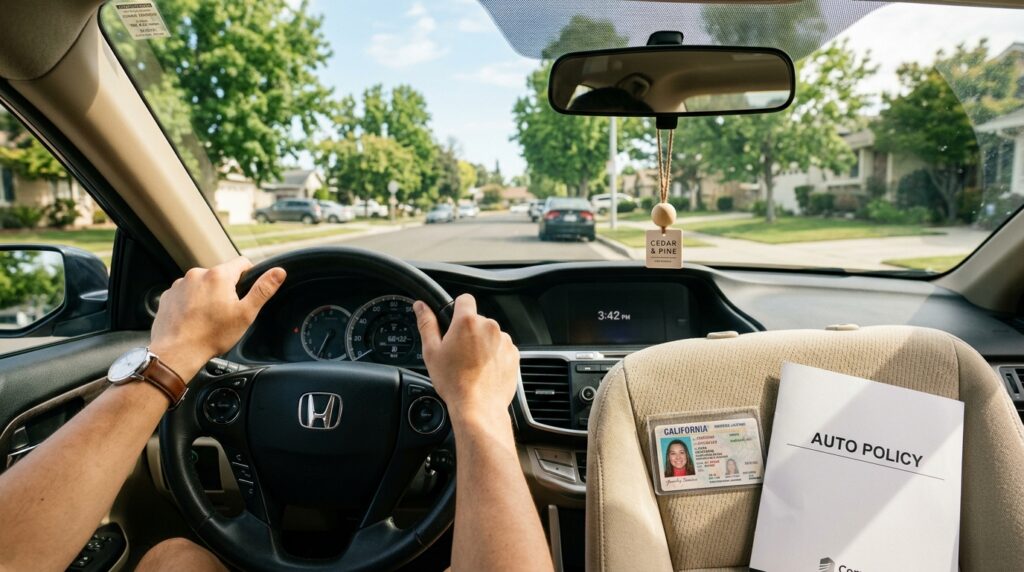
When my younger brother finally passed his road test, our family had a mini-celebration. The freedom of having a newly minted driver’s license is unmatched. But that evening, the excitement evaporated into thin air when my dad called our insurance company to add him to the family policy.
The agent quoted an additional $300 a month. For a 10-year-old sedan.
“Is this a typo?” my dad asked. It wasn’t. To the insurance industry, a first-time driver—whether they are a 16-year-old high schooler or a 30-year-old urbanite who finally decided to buy a car—is essentially a walking question mark. Because you have no historic data or driving record, the algorithms default to the highest possible risk bracket. Recent marketplace data reveals that insuring a brand-new driver on a standalone full-coverage policy can easily clear $300 to $500 a month.
It feels deeply unfair, but you don’t have to just accept the sticker shock. If you are navigating the complex, confusing waters of buying car insurance for the very first time, here is the field-tested guide on how the system works, what pitfalls to dodge, and how to artificially accelerate your path to affordable rates.
The Core Blueprint: What Every First-Time Driver Needs
Before shopping for quotes, you need to understand the structural layout of an insurance policy. If you don’t know the terminology, a slick agent can easily sell you expensive add-ons you do not need, or conversely, leave you underinsured.
Auto policies are divided into three essential, foundational pillars:
[ Your Policy ]
       │
       ├───► Liability Coverage (Protects other people & their property)
       │
       ├───► Collision Coverage (Fixes YOUR car if you hit something)
       │
       └───► Comprehensive Coverage (Fixes YOUR car if life happens: hail, theft, animals)
- Liability Coverage: This is the legal baseline. If you run a red light and smash into someone else, liability pays for their medical bills and their car repairs. It does not pay a single cent to fix your car.
- Collision Coverage: This covers repairs to your own vehicle if you collide with another car, a guardrail, or a tree, regardless of who caused the accident.
- Comprehensive Coverage: This is protection against “acts of God” or random life events. If a deer jumps in front of your car, a hailstorm dents your roof, or someone shatters your window to steal your stereo, comprehensive covers it.
4 Proven Strategies to Cut New-Driver Costs Instantly
If you apply for a standard policy out of the blue, you are going to get slaughtered on the price. Instead, use these deliberate strategies to alter the risk equation in your favor.
1. The Parent Piggyback Trick (The #1 Money Saver)
If you live in the same household as your parents or a partner who has a long, clean driving history, do not get your own separate policy.
Getting a standalone policy as a brand-new driver under 25 can cost upwards of $4,500 a year. However, if your parents add you as a secondary driver to their existing, established policy, the total household premium will still go up, but it will typically cost roughly half of what a standalone policy would.
The Lesson Learned: You get to inherit their “loyalty” status and multi-car discounts while naturally building up your own continuous insurance history. After a few years of clean driving on their policy, you can transition to your own standalone plan with a proven track record.
2. Gamify Your Commute with Telematics
Almost every major insurance carrier now offers an app-based tracking program, such as State Farm’s Drive Safe & Save, GEICO’s DriveEasy, or Progressive’s Snapshot.
These programs track your speed, acceleration, braking severity, phone usage while driving, and what time of night you are on the road. As a new driver, enrolling in these programs typically yields an instant 10% to 15% discount just for signing up.
If the app records that you maintain safe distances, avoid hard braking, and keep your phone in the cupholder, that discount can scale up to 30% upon policy renewal. It’s an easy trade-off if you drive cautiously.
3. Cash In on the “Good Student” Tier
If you are currently a high school or college student, your report card is directly tied to your insurance premium. Insurance actuaries discovered a strong mathematical correlation between high academic performance and responsible driving habits.
If you maintain a B average or a 3.0 GPA, most insurance companies will slash your premium by 10% to 15%. All you have to do is upload a screenshot of your report card or a transcript into your customer portal once a semester.
4. Drive a Boring, Safe Car
When you are a first-time driver, your vehicle choice is a massive financial lever. If you buy a high-horsepower sports car or a luxury sedan with complex carbon-fiber body panels, your premium will be astronomical because those cars are statistically crashed more often and cost a fortune to repair.
Instead, opt for a safe, mid-sized sedan or a compact SUV (like a Toyota RAV4 or a Honda Civic). These vehicles possess excellent safety ratings, have affordable parts, and are viewed favorably by underwriting algorithms, saving you thousands in your first few years behind the wheel.
Step-by-Step: Buying Your First Policy
When you are ready to pull the trigger and purchase coverage, follow this exact procedural roadmap to avoid overpaying:
1.Gather Your Core Information:Takes 10 mins.
Before requesting a quote, have your driver’s license number, the Vehicle Identification Number (VIN) of the car you intend to drive, and your physical odometer reading ready.
2.Request Quotes Across Three Tiers:Compare 3+ companies.
Run your data through at least three competing companies (look at State Farm, Travelers, and GEICO, as they historically offer the most aggressive new-driver discounts). Ensure you select identical coverage limits across all three companies so the comparison is fair.
3.Select Your Deductible Threshold:Financial safety net.
Choose your deductible. If you have at least $1,000 sitting securely in a savings account, opt for a $1,000 deductible instead of a $500 one. This simple tweak forces your monthly premium down instantly.
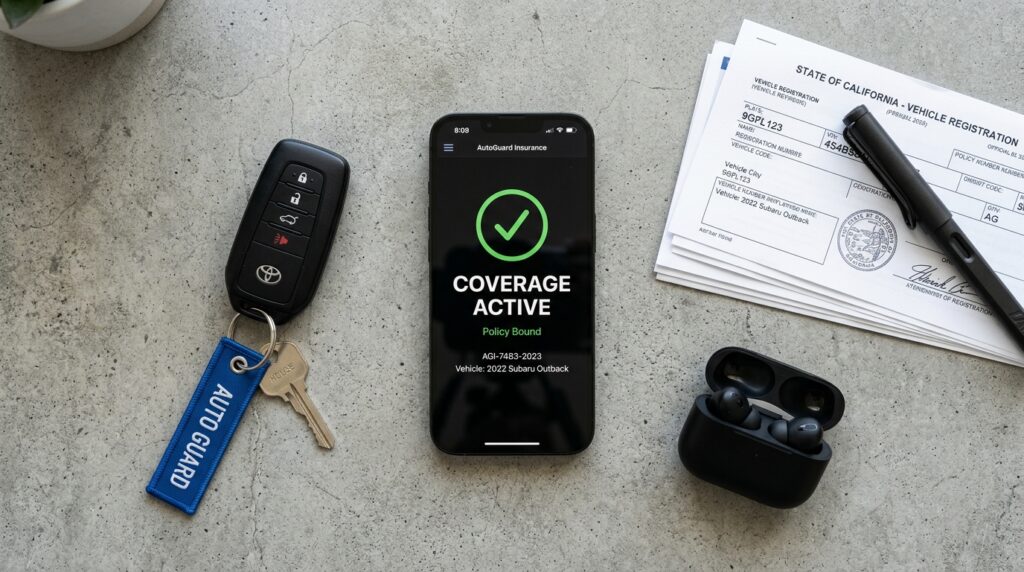
4.Bind and Fund the Policy Upfront:Avoid convenience fees.
Once you select a carrier, opt for paperless billing and automatic pay. If you can afford the cash hit, pay the entire 6-month premium upfront to completely wipe out monthly installment fees and trigger a “Paid-In-Full” discount.
3 Fatal Mistakes First-Time Drivers Make
Avoid these common traps that catch rookie drivers off guard:
| Mistake | What Happens | The Better Way |
| Buying a policy after driving the car home | If you buy a car and drive it off the lot without active insurance, you are breaking the law and face immediate fines or a vehicle impound. | Never drive a newly purchased vehicle until you have called an insurer, funded the policy, and received digital insurance cards. |
| Buying bare minimum state limits | State minimums (like a $25,000 property limit) sound cheap, but if you accidentally rear-end a modern electric vehicle, $25,000 won’t even cover their battery replacement, exposing you to personal lawsuits. | Opt for at least 100/300/50 liability limits—the price difference is usually only a few dollars more a month, but the protection is tenfold. |
| Forgetting to update mileage | If you tell an insurer you commute 40 miles a day, but your school or job switches to a remote format, you will continue paying an inflated rate. | Review your policy declarations every 6 months and adjust your annual mileage down if your actual driving habits drop. |
Final Thoughts
Your first year of driving will undoubtedly be your most expensive from an insurance standpoint. Think of it as a probationary period. If you can make it through your first 12 to 24 months without a speeding ticket, an at-fault accident, or a coverage lapse, your rates will naturally begin to drop.
Treat your insurance premium like an active project: stay on top of your discounts, track your driving carefully on your provider’s mobile app, and don’t hesitate to re-shop your policy the moment you hit your two-year driving anniversary.