
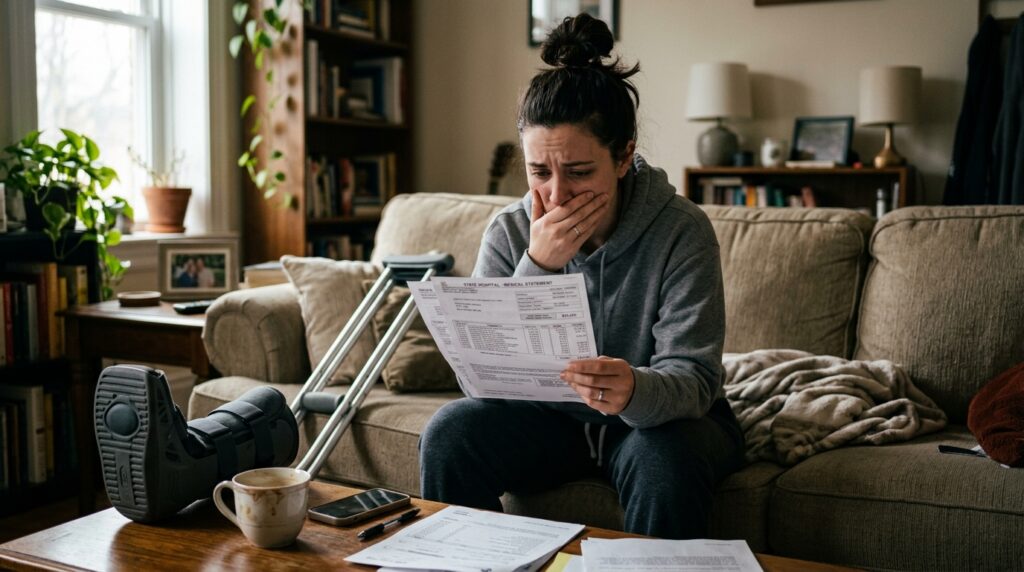
When I was 24, I felt completely invincible. I was eating decently, exercising, and working a contract gig that didn’t provide benefits. When it came time to look into buying my own health insurance plan, I saw the $300 monthly premium and thought, “I’m completely healthy. Why am I going to throw away $3,600 a year just to have a plastic card in my wallet?”
I decided to opt out. I felt like a financial genius for saving that cash every month.
Then came a rainy Tuesday evening when I tripped over a loose brick on a sidewalk, landed awkwardly, and felt an immediate, sickening pop in my left ankle. Sitting on the wet concrete, my very first thought wasn’t about the excruciating pain—it was pure, unadulterated panic about how much this was going to cost me without insurance.
That mistake cost me nearly $4,200 for a single emergency room visit, an X-ray, an orthopedic boot, and two follow-up appointments. I spent the next 18 months paying off that single misstep.
If you are currently skipping health insurance to save money, or if you’re transitioning out of a job and thinking about letting your coverage lapse, you need to understand exactly how the American healthcare system treats uninsured people. It’s not just a gamble on your physical health; it is an active threat to your financial survival.
Let’s pull back the curtain on exactly what happens if you don’t have health insurance in the US, the hidden penalties you might face, and the safety nets available to keep you protected.
1. The Financial Reality: The “Chargemaster” Trap
The single biggest misconception people have about going uninsured is thinking, “I’ll just pay the doctor out of pocket if I get sick. It can’t be that much more than the insurance copay.”
This logic completely falls apart because of a hidden industry mechanism known as the hospital changemaster.
Insurance companies are massive corporate entities that negotiate deep, institutional discounts with hospitals. If an insured person goes to the hospital for a procedure, the hospital might bill the insurance company $10,000, but the negotiated “in-network rate” might only be $2,500.
When you walk into a hospital without insurance, you have zero negotiation leverage. The hospital charges you the maximum, unnegotiated sticker price from their changemaster list. That means an identical procedure that costs an insurance company $2,500 can easily result in a $15,000 bill sent directly to your mailbox.
2. The Legal Penalty Reality in 2026
A lot of people think the “Individual Mandate” (the tax penalty for not having health insurance under Obamacare) was completely abolished. That is only partially true.
At the federal level, the tax penalty was reduced to zero. That means the IRS will not fine you on your federal tax return for being uninsured. However, several states stepped in to pass their own state-level individual mandates.
If you live in one of these jurisdictions and go uninsured without a valid hardship exemption, you will face a substantial penalty deducted directly from your state tax refund or added to your state tax bill this year:
| State / Territory | 2026 Flat Fee Penalty (Per Adult) | Percentage-of-Income Penalty |
| California | $950 | Or 2.5% of household income (whichever is higher) |
| District of Columbia | $795 | Or 2.5% of household income (whichever is higher) |
| New Jersey | $695 | Or 2.5% of household income (whichever is higher) |
| Rhode Island | $695 | Or 2.5% of household income (whichever is higher) |
| Massachusetts | Varies by income | Up to $135 per month ($1,620 annually) |
The Math Lesson: If you are a single professional living in California earning $65,000 a year and you go uninsured all year, you won’t just owe the $950 flat fee. The state will calculate 2.5% of your income above the filing threshold, meaning you could easily owe over $1,000 in penalties at tax time for absolutely nothing in return.
3. The Emergency Room Illusion (EMTALA)
Another incredibly dangerous myth is: “Hospitals legally can’t turn me away, so the ER is my free healthcare plan.”
This myth stems from a federal law called EMTALA (Emergency Medical Treatment and Labor Act). Under this law, any hospital emergency room that accepts Medicare funding is legally required to screen and stabilize anyone who walks through the door experiencing a life-threatening medical emergency or active labor.
If you are bleeding out from a car crash, they will patch you up. If you are having a massive heart attack, they will save your life.
But “stabilizing” you does not mean treating you for free.
The moment you are out of immediate danger, the billing department kicks into overdrive. They will catalog every single piece of gauze, every milligram of IV fluid, and every minute of a physician’s time, sending you a massive invoice. If you cannot pay, that bill is eventually sent to aggressive third-party collection agencies.
Furthermore, EMTALA does not apply to non-emergency care. If you have a severe chronic illness like diabetes, asthma, or a suspicious lump that could be cancer, an ER is not legally required to manage your long-term treatments, chemotherapy, or maintenance prescriptions. Without health insurance, specialty clinics and doctors’ offices will typically refuse to even place you on their schedule unless you can pay their entire consultation fee upfront at the front desk.

Step-by-Step: What to Do If You’re Uninsured Right Now
If you currently find yourself without health insurance due to a recent job loss or a tight budget, don’t just stay exposed. Follow this exact procedural roadmap to find an affordable, compliant safety net:
1.Check Your Eligibility Window:Trigger a Special Enrollment Period.
If you lost your job-based health insurance within the last 60 days, you qualify for a Special Enrollment Period (SEP). This allows you to bypass the standard winter open enrollment dates and buy a policy immediately.
2.Log Onto the Official Marketplace:Avoid scam advertising sites.
Go directly to HealthCare.gov. If you live in a state with an independent exchange (like New York or California), the site will securely redirect you to your official state portal. Do not use generic search engines to find quotes, or you will be flooded with spam calls from non-compliant brokers.
3.Input Your Projected MAGI:Calculate your true subsidy.
Enter your projected Modified Adjusted Gross Income (MAGI) for the upcoming year. If your income has dropped due to job loss, the system will calculate an expanded premium tax credit. If you make under 150% of the Federal Poverty Level, the subsidies are often so aggressive that they completely cover the cost of a plan, giving you an official $0 monthly premium.
4.Screen for Medicaid Expansion:Look into state safety nets.
If your income is exceptionally low (below 138% of the poverty line) and you live in one of the 40 states that expanded Medicaid, the marketplace portal will automatically route your application to your state’s Medicaid program for completely free, comprehensive healthcare coverage.
Common Mistakes to Dodge While Uninsured
- Buying “Short-Term” Fixed Indemnity Plans: If you search for cheap health insurance online, you will likely stumble across plans offering coverage for $70 a month. Read the fine print carefully. These are almost always short-term indemnity plans that do not comply with the Affordable Care Act. They are legally permitted to deny coverage for pre-existing conditions, refuse to cover prescriptions, cap your annual benefit payouts, and drop your coverage entirely the minute you file an expensive claim.
- Letting Medical Bills Destroy Your Credit Score: If you already ran up an emergency room bill while uninsured, don’t just ignore the letters. Call the hospital’s billing department immediately and ask to speak with a patient financial counselor. Request a Financial Hardship Application or ask for their Charity Care Program. By law, non-profit hospitals are required to provide sliding-scale discounts or complete bill forgiveness based on your income, but you have to actively apply for it before it goes to a collections agency.
Final Thoughts
Going without health insurance in the United States isn’t an act of financial frugality; it’s a high-stakes gamble where the house always wins. A single unexpected medical event can instantly erase years of hard work, wreck your credit score, and accumulate debt that takes decades to resolve.
With the expanded subsidies available on the official ACA marketplace, shielding yourself with a compliant healthcare plan is more accessible than ever before. Take an hour out of your day to log onto HealthCare.gov, plug in your numbers, and protect both your physical health and your financial future.