

A few months back, I opened my inbox and saw my upcoming car insurance renewal notice. I expected a slight bump—everything has felt more expensive lately—but my jaw dropped when I saw the actual number. My premium had spiked by nearly 20%, despite my driving record being completely clean. No tickets, no accidents, and I was driving the exact same car.
It felt like a penalty for just existing.
Instead of grumbling and blindly clicking “pay,” I decided to treat my insurance bill like a broken piece of code. I dug into the data, tested a dozen different tactics, spent hours researching industry pricing shifts, and negotiated like my budget depended on it. By the time I was done, I didn’t just wipe out the 20% increase—I actually managed to cut my previous rate in half.
The reality is that auto insurance prices have skyrocketed over the last few years due to high repair costs and inflation. But you don’t have to just accept it. If your premiums are eating a hole in your wallet, here are 10 hands-on, field-tested ways to slash your car insurance bill.
1. Shop Around (The 3-Year Itch)
The biggest mistake I ever made was assuming my loyalty to a specific insurance provider mattered. It doesn’t. In the insurance world, there is a concept called price optimization. Insurance companies use data to predict which customers are likely to stay loyal even if their rates go up. If you’ve been with the same insurer for five years, you might actually be paying a premium for your loyalty.
Every three years, or whenever you have a major life change (moving, getting married, buying a home), you should actively shop around.
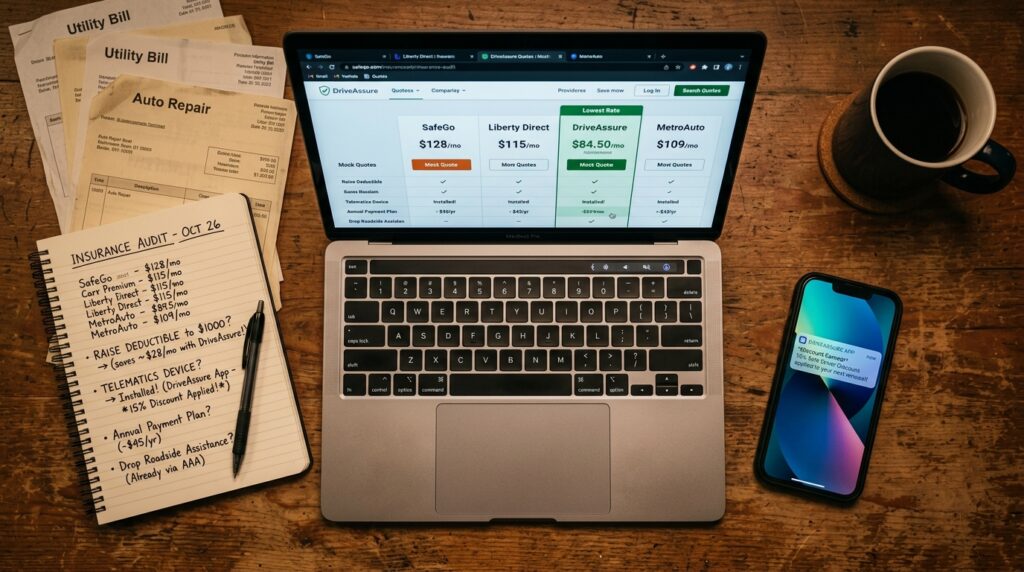
When I did this, I gathered quotes from five different major carriers. I found that identical coverage limits varied by as much as $90 a month between companies. You can use free tools like Insurify or Jerry to quickly compare multiple rates at once without getting slammed by spam calls.
2. Play the Deductible Slider Game
Your deductible is the out-of-pocket cash you have to pay before your insurance covers a claim. If you have a $250 or $500 deductible, you are paying a massive premium for the peace of mind that a minor fender bender won’t disrupt your cash flow.
If you have a solid emergency fund, raising your deductible to $1,000 or $2,500 is one of the fastest ways to drop your premium instantly.
When I raised my comprehensive and collision deductibles from $500 to $1,000, my monthly premium dropped by roughly 15%. However, you have to be honest with yourself: if you get into a wreck tomorrow, do you actually have that $1,000 sitting in a bank account ready to go? If yes, make the switch.
3. Audit Your Existing Coverage Lines
Take a look at your actual policy line items. Most people just look at the total monthly cost, but your policy is built like a buffet. You might be paying for things you don’t actually need.
- Roadside Assistance: Are you paying $4 a month for your insurer’s roadside assistance when you already have a AAA membership or roadside coverage through your credit card?
- Rental Car Reimbursement: Do you have a secondary vehicle at home you could use if your primary car is in the shop? If so, you can drop rental reimbursement coverage.
- The “Clunker” Rule: If you drive an older vehicle that is paid off—say, a 2012 Honda Civic worth around $4,000—paying for collision and comprehensive coverage might be a losing mathematical game. If your annual premium for those coverages plus your deductible equals more than the car is worth, drop down to liability-only.
4. Let a Tracking Device Spy on Your Driving
If you don’t mind a little corporate surveillance, telematics programs (the apps or plug-in devices that track your driving behavior) offer deep discounts. Programs like Progressive Snapshot, State Farm Drive Safe & Save, or Allstate Drivewise monitor how hard you brake, how fast you accelerate, what time of day you drive, and how much you use your phone.
I tried one of these for six months. I’ll admit, it fundamentally changed how I drive. I found myself coasting to red lights and leaving massive gaps between me and the car ahead just to avoid a “hard braking” penalty on the app.
The Lesson Learned: If you have a heavy foot, skip this. Some companies can actually raise your rates if the data shows you drive aggressively or spend a lot of time on the road at 2:00 AM. But if you work from home and drive like a grandparent, it can easily shave 20% to 30% off your bill.
5. Clean Up Your Credit Score
Many drivers have no idea that in most states, your credit score has a massive impact on your auto insurance premium. Actuaries have analyzed millions of data points and concluded that drivers with lower credit scores statistically file more claims.
I watched a friend of mine struggle with high insurance rates for years. Once he spent a year focusing on paying down his credit card balances and pulling his credit score up from the low 600s to the mid-700s, his auto insurance premium dropped by nearly a third upon renewal—without changing a single thing about his coverage.
Note: If you live in California, Hawaii, or Massachusetts, state laws ban insurance companies from using credit scores to set rates. For everyone else, improving your credit profile is a stealth insurance hack.
6. The “Invisible” Bundling Discounts
Everyone knows about bundling home and auto insurance. It’s the oldest trick in the book, and it usually yields a solid 10% to 15% discount. But what if you rent, or own a condo, or don’t have another major policy?
Look for alternative multi-policy setups. Bundling a cheap $12-a-month renters insurance policy can sometimes trigger a multi-policy discount on your auto insurance that is larger than the cost of the renters policy itself. You essentially get free renters insurance and a lower car insurance bill simultaneously.
7. Maximize the Low-Mileage Reality
The shift toward hybrid and remote work has fundamentally changed how much we drive, yet many people are still paying premiums based on old commutes.
Log into your insurance portal and check what your policy lists for your “estimated annual mileage.” If it still says 12,000 or 15,000 miles, but you only drive to the grocery store and the local coffee shop now, call your agent immediately. Lowering your estimated annual mileage to under 7,500 miles can trigger a significant low-mileage tier discount.
If you drive even less than that (under 5,000 miles a year), look into pay-per-mile insurance companies like Metromile or Mile Auto, where you pay a low flat base fee plus a few cents for every mile you actually drive.
8. Pay the Full Bill Upfront
Most insurance companies charge a small convenience or installment fee (usually $3 to $7) every single month if you split your premium into monthly payments. On top of that, they miss out on the “paid-in-full” discount.
If you can manage the cash flow hit, paying your 6-month or 12-month premium entirely upfront usually yields an immediate 5% to 9% discount. Combine that with opting for paperless billing and automatic text alerts, and you can knock another $50 off the total bill for doing absolutely nothing.
9. Leverage Group “Affinity” Discounts
Insurance companies love low-risk groups, and they partner with hundreds of organizations to offer hidden discounts. When you are getting a quote, look closely at the “Affiliations” or “Professional Groups” dropdown menu.
You can often get a discount for being an alumnus of a specific university, a member of a credit union, a military veteran, a teacher, an engineer, or a member of certain professional organizations or fraternities. I once saved 5% just by proving I was a member of a local tech professional group. It takes two minutes to check, and the savings are permanent as long as you remain a member.
10. Take a Defensive Driving Course (Even as an Adult)
We tend to think of defensive driving courses as a punishment handed down by a judge to wipe a speeding ticket off our record. But taking a voluntary, state-approved defensive driving course online is a completely legitimate way to secure a guaranteed discount.
Companies like Idrivesafely or the National Safety Council offer online courses that take a few hours to click through on a Saturday afternoon and cost around $20 to $30. In many states, completing one of these courses mandates an automatic 5% to 10% discount on your liability and collision coverage for three full years. The math easily works out in your favor.
Common Pitfalls to Keep in Mind
While chasing the lowest possible premium, it is incredibly easy to make a mistake that could cost you thousands of dollars down the road.
| Mistake | Why it Hurts | Better Approach |
| Dropping to state minimums | If you cause a serious multi-car accident, state minimum liability limits (like 15/30/5) can be wiped out in minutes, leaving your personal assets vulnerable to lawsuits. | Keep your liability limits high ($100k/$300k) and save money by adjusting deductibles or shopping around instead. |
| Letting coverage lapse | Allowing your insurance to lapse for even a single day puts you in a “high-risk” bracket. When you try to get a new policy, your rates will skyrocket. | Always secure your new policy and confirm its start date before canceling your old one. |
| Hiding a second driver | Failing to list a teenager or a spouse who lives with you to save money is considered material misrepresentation. The insurer can deny your claim if they crash. | Be honest about household drivers, but aggressively utilize “good student” or “student away at school” discounts to offset the cost. |
Final Thoughts
At the end of the day, car insurance is a necessary expense, but you shouldn’t treat it like a fixed utility bill. The insurance market shifts constantly, and the algorithms companies use to price risk are always evolving.
If you haven’t touched your auto insurance policy in over a year, you are almost certainly leaving money on the table. Take an hour this weekend, log into your account, pull up your declarations page, and start testing these steps. Your bank account will thank you.